
🇹🇷 Türkçe
🇬🇧 English

Climate Scientist & Strategist | Author of Son Buzul Erimeden
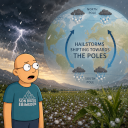
A new study just published in Nature Climate Change has mapped how hailstorms will shift as the planet warms. The finding is counterintuitive: Hail isn’t disappearing. It’s moving. As warming increases, the atmospheric conditions that produce hail are drifting toward the poles. Mid-latitude regions may see less. But northern Europe, Canada, southeastern Australia, and New Zealand are moving into rising-risk territory. And there’s a seasonal dimension too: the shift is from summer to winter — which is precisely when wheat and other winter crops are in the ground. A companion study in Nature adds to the picture: large hailstones (≥30 mm) are projected to become 38–52% more common globally by century’s end, with total hail damage rising 36–42%. Europe is already experiencing this shift. Hailstorms there have surged 267% in just five years. Two consecutive record-loss seasons — €5 billion each. For agriculture, insurance, urban planning, and anyone watching food security: the geography of extreme weather is being redrawn in real time.
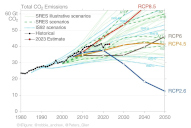
The good news: Global emissions have flattened since 2014. Solar costs have dropped over 90%. Clean energy investment hit $1.1 trillion in 2022. The very worst climate scenario appears to have been avoided.
The bad news: Flattening is not improvement. CO₂ is cumulative. The planet keeps warming until net emissions hit zero. And Germany — arguably the world’s most institutionally equipped democracy for climate action — just had its independent Climate Council confirm it will miss its 2030 and 2040 targets by 60–100 million tonnes.
In a new piece on Before the Last Glacier Melts, I argue this isn’t just a German problem. When the strongest performers stumble, the ripple effects are global: enforcement mechanisms like the EU’s CBAM lose credibility, finance pledges to developing nations weaken, and the political argument of “if they can’t do it, why should we?” grows louder.
For Türkiye, the stakes are concrete. The 2024 Climate Law was driven largely by CBAM pressure. If that pressure softens, what takes its place?
This is not pessimism. It is evidence-based realism.
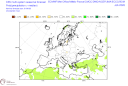
Summer 2026 forecast is in — and it’s intense 🌡️🌍
According to the latest Copernicus C3S seasonal outlook, Central and Eastern Europe are heading into a summer with temperatures 1 to over 2°C above normal. Turkey sits right at the epicentre of this heat anomaly.
But here’s the twist: the Eastern Mediterranean — including Turkey and Greece — also shows a 60–70% probability of above-median rainfall this summer. Heat waves and heavy rain events? That’s the new normal we need to prepare for.
Whether you’re in agriculture, urban planning, energy, or just planning your summer — this forecast matters.
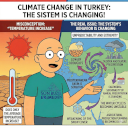
The Holocene was a geological “lucky break” for humanity. For nearly 12,000 years, climate stability allowed us to build cities and develop agriculture. That era is over.
In my latest piece, I discuss why we must stop treating climate change as a series of isolated weather events and start seeing it as a systemic exit from the stability that made civilization possible. Our infrastructure and food security models are built on a “predictability” that has vanished.

COP31 is coming to Antalya. But are we ready? 🌍
A thought-provoking new article on Before The Last Glacier Melts makes the case that the real value of COP31 isn’t in the two-week conference — it’s in the rare “climate window” opening around it.
For the next 2–3 years, international finance, technology, partnerships, and policy attention will all converge on Türkiye at once. That doesn’t happen often.
✅ For business: transform genuinely, and communicate it credibly
✅ For public institutions: make policy progress visible
✅ For civil society: bring climate into everyday life
The article ends with a question that stays with you:
“Will we be mere spectators of this process — or will we become one of the actors shaping it?”
Where do you stand?

Nature just published a sobering milestone: we have officially lived through the 11 hottest years on record. This isn’t just a “streak”—it’s a systemic shift.
As we look at these data points, we must stop asking when things will “return to normal.” Normal has been redefined. For those of us in strategy and resource management, this means our risk models must account for a permanent state of escalation. The time for incrementalism has passed; we are now in an era of mandatory adaptation.
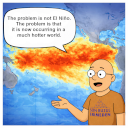
The debate shouldn’t be about whether a “Super El Niño” is coming—it’s about the state of the planet it is entering. We are no longer in the same climate system that hosted past El Niño events. With massive heat accumulation in the Pacific, we are likely looking at a “Super” impact regardless of the event’s official classification. Late 2026 and 2027 are set to be a significant test for our global food systems and water infrastructure. 🌍📉

The “Green Transition” is hitting a physical wall: Copper. A new analysis in The Conversation highlights a looming 10-million-ton structural deficit by 2040. As EVs, renewable grids, and AI data centers scale simultaneously, demand is outpacing extraction capacity. This is not just a funding issue — it is a constraint of material reality. With 17-year lead times for new mines and growing water scarcity in key regions, copper risk is becoming a structural bottleneck for both industrial growth and climate targets.